Author Archives: admin

Purple Yam Restaurant: Not Precisely Filipino

I’ve always wondered why there aren’t any Filipino restaurants in Brooklyn. Are Brooklynites’ palates too refined for the bold flavors of Filipino cuisine?

In years of cooking I’ve seen a lot of wrinkled noses when I say the words “fish sauce,” and have heard many complaints about the strong acid aromas of any good adobo in process. But I always thought it was a matter of real estate prices that there weren’t any accessible places where I could easily scratch a Pinoy food itch.

And so I was very happy to hear that friends had tried and successfully enjoyed meals at Purple Yam in Ditmas Park since they opened. Built by the Manhattan “Filipino fusion” restaurant Cendrillon‘s owners, NYT food critic Sam Sifton was actually pleased when he visited Amy Besa and Romy Dorotan’s new joint a few steps from the Q train in Ditmas Park.

After many friends raved about the new taste, and remembering Romy’s statement in the NYT article that most Pinoy’s don’t consider this their mother’s cooking, we gave it a shot and were pleasantly surprised. Purple Yam is a food experience that stands on its own, especially in an area where the closest competition is a bakery that sells cracked cheesecakes and Spongebob Squarepants cookies.

We began with the okoy, battered and fried vegetable fritters with big pieces of shrimp. It was hot and tasty served with a diluted duck sauce. Continue reading

Frank and The Whole Roasted Pig

Frank Piazza of the Piazza Brothers Winery approached us with a bottle in his hand. We were there for the Sopressata Making Class, an occasion good as any to showcase the winery’s collection.

“See this guy on the label?” Frank Piazza asked. On the label was a blue photo of a guy posing in a manner that must have been trademarked by James Dean – sitting on a set of steps, one foot resting higher than the other, arms leaning lazily the way only a carefree young man would. 

“That’s me,” said Frank.

Of course it was. The last time we were approached by an older gentleman who claimed it was his younger self on a wine bottle’s label, we were at a wine store in Brooklyn and the man was a goon in one of the older Godfather movies. How appropriate that we’d hear the same line again, but this time, in a non-descript warehouse in Staten Island beside an adult video store. Should we have started looking over our shoulders?

Instead Frank Piazza took it upon himself to sit us down and demonstrate the “proper” way to taste wine. Other than the usual nosing and legs examination, he prompted us to take a bit of wine a keep it for a few seconds in the front of our mouths, pooling around our bottom incisors.

“Okay,” he said, “now slowly move your tongue around it, then swallow.”

As he predicted our tongue split into several parts, the sides tingling from the acid of the wine, the tip from the sweetness, the back from the bitterness. I had never tasted wine like this before, and being no connoisseur, a new way was welcome. (Of course after further reading, apparently the existence of the tongue map is insgnificant, but I still thought it was pretty cool to demarcate the areas of your tongue with a sip of wine.)

After the class a whole roasted pig was served, and he cut it so expertly that I began to doubt the expertise of the  butchers I watched in my homeland.

We explained to the wine and sausage makers that a whole roasted pig was a fixture in Filipino parties. They smiled and said this one was actually from Chinatown. That explained the Five Spice Powder taste it had about it.

Either way we feasted, crunched on the skin, and I was able to scam the head to make some lechon paksiw. Good times!
Thanks, Frankie!

Frank Carves a Whole Roasted Pig

My plate of crispy skin, pasta and salad.
The head I scammed and took home to make Lechon Paksiw (recipe next post).

Shakshuka AKA Delicious – Eggs Poached in Tomato Sauce, Chickpeas and Feta

They said the dish was called Delicious and that’s exactly what it was. One morning in our Vermont ski rental, the air was filled with the flavors of tomato, jalapeno and feta because of this colorful palette of reds, greens and yellows.

“It’s not really called Delicious, we just named it that,” our friends said. Upon further investigation I discovered that the dish was actually called shakshuka, a North African dish popular in Israel and in the Middle East.


Tomatoes are stewed and reduced with the addition of jalapeno and feta, and then eggs are poached in the mixture as it spends a few minutes in the oven.

We served it with rice but recipes online sometimes call for tortillas or pita. I think it’s excellent on its own, and definitely a dish to share. I love pretty food!

Shakshuka
  
Ingredients
  • 1/4 cup olive oil
  • 1 medium onion, finely chopped
  • 4 garlic cloves, coarsely chopped
  • 2 jalapeños, seeded, finely chopped
  • 1 15-ounce can chickpeas, drained
  • 2 teaspoons Hungarian sweet paprika
  • 1 teaspoon ground cumin
  • 1 28-ounce can whole peeled tomatoes, crushed by hand, juices reserved
  • Kosher salt and freshly ground black pepper
  • 1 cup coarsely crumbled feta
  • 8 large eggs
  • 1 tablespoon chopped flat-leaf parsley
  • 1 tablespoon chopped fresh cilantro
  • Warm pita bread

Preparation

  • Preheat oven to 425°. Heat oil in a large ovenproof skillet over medium-high heat. Add onion, garlic, and jalapeños; cook, stirring occasionally, until onion is soft, about 8 minutes. Add chickpeas, paprika, and cumin and cook for 2 minutes longer.

  • Add crushed tomatoes and their juices. Bring to a boil, reduce heat to medium-low, and simmer, stirring occasionally, until sauce thickens slightly, about 15 minutes. Season to taste with salt and pepper. Sprinkle feta evenly over sauce. Crack eggs one at a time and place over sauce, spacing evenly apart. Transfer skillet to oven and bake until whites are just set but yolks are still runny, 5–8 minutes. Garnish with parsley and cilantro. Serve with pita for dipping.

Short Rib Adobo With Coconut Milk – When The Whiteys Cooked Filipino Food

I won’t make ramen for a Japanese friend, nor will I cook pasta for an Italian chef. As a food enthusiast I know my place and know enough to not to make something for someone if they already make the exact same dish perfectly.

Except that I said yes when our friend Jessica told me about the adobo recipe she found in the New York Times. I wrinkled my forehead when I heard “coconut milk,” imagining Thai food or some kind of strange milky variation. I tried not to flinch when I saw shoyu (Japanese fermented soy sauce) as an ingredient. I didn’t butt in and say you can only use Filipino soy sauce! The meat of choice was short rib. It was hard to go wrong.

But I was wowed, no, floored with delight when the dish was done. The shoyu and chicken broth allowed for the saltiness while keeping the light color of the stew. The coconut milk added a subtle depth to the dish, the apple cider vinegar created a whole new dimension to the acid, and the searing and broiling process made the meat delectably golden and crispy. I was sufficiently and pleasantly impressed.

Served over rice with a side of steamed bokchoy. Yes, those are whole cloves of garlic.

We soaked our rice with the sauce and ate more than we should. This is how one honors a chef (myself included). In the morning we turned the leftover sauce and rice into Adobo Fried Rice. During both meals we shared great conversation and an even greater love for life.

These whiteys can make me my cuisine anytime.

More on adobo here. My Crispy Pork Belly Adobo recipe here.

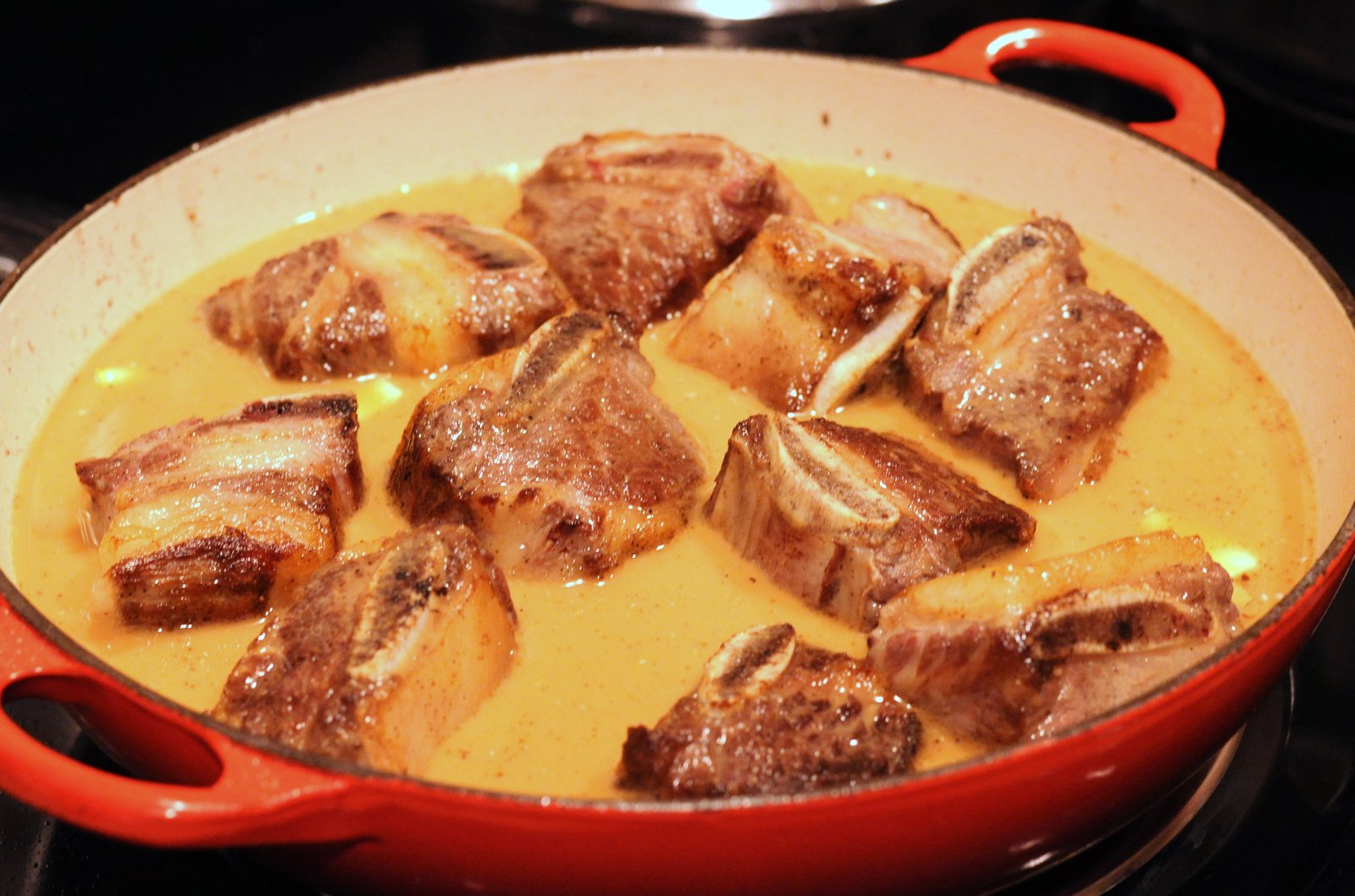
Short ribs are browned on all sides.

The rest of the ingredients are added: shoyu, vinegar, coconut oil, broth, bay leaf, garlic.
The Dutch oven is covered and made to simmer in the oven for two hours.
The meat is removed from the pot and transferred to a pan to broil until brown and crispy.
It is returned to the sauce before serving.
Heavenly perfection.

(Incidentally, this recipe comes from Amy Besa and Romy Dorotan, owners of the Brooklyn joint Purple Yam.)

From The New York Times


Beef Short-Rib Adobo
Time: 2 1/2 hours
3 pounds short ribs
1/2 teaspoon kosher salt
Black pepper
3 tablespoons oil
1 cup chicken stock
1 cup coconut milk
1 cup cider vinegar
1/2 cup soy sauce
1 head garlic, cloves separated and peeled
3 bay leaves.
1. Heat the oven to 275 degrees. Season the ribs all over with salt and pepper. In a large Dutch oven over medium heat, pour in the oil. When it is warm but not smoking, add the ribs to the pan, in batches if necessary, and brown well on all sides, 4 to 6 minutes. Remove the ribs from the pan and pour out the oil.
2. Add the remaining ingredients and 1 teaspoon black pepper, stir well, and add the ribs back in one layer. Use two pans if necessary, distributing the liquid. Bring to a boil over high heat. Turn off heat, cover the pan and put it into the oven. Cook until the meat is tender and falling off the bone, about 1 1/2 to 2 hours. The liquid should only simmer very gently. Skim off excess fat when you check on it.
3. Transfer ribs to a broiling pan. Put the braising liquid over high heat; boil for 10 to 15 minutes to thicken it. Meanwhile, put the ribs under the broiler until brown. (You can dispose of the bones if they become loosened.) Put ribs on a platter; pour sauce on them.
Yield: 4 servings.
Note: You can double the recipe, and cook the ribs in two layers. Cooking time will be a bit uneven, though, so it’s best to try to turn over the ribs halfway through the cooking.

Favorite Things: Vermont Cultured Butter

I love being wowed by simple things. For instance, a butter so rich and tasty it makes you wonder why you wasted your time on all the other “ordinary” butters, watching out for special sales to get them even cheaper, dousing or smearing your food item with so much of it because you can’t seem to produce the taste you’re looking for. It’s not you. It’s it.

Vermont Creamery Butter at the Food Coop – $3 cheaper than retail is not bad at all!

Enter the world of cultured butters. Often called “European style butters,” cultured butters undergo the step of fermentation, where the cream that has accumulated on the top during milking is allowed to ferment (naturally or artificially through bacterial strains) into the popular creme fraiche before churning it into a butter.


As a result, cultured butters have a little bit of tartness to them, owing to a process that has been omitted in the production of mainstream “sweet cream” North American butters, rendering them still rich in fat but
lacking in the distinct taste produced by fermentation, one that allows that knock-your-socks out buttery taste all within the first minor swipe.

Vermont Creamery Cultured Butter is one of those butters that produce that flavor explosion. Typically selling for $6-7 retail for a half pound, the Food Coop brings it to members for a ridiculous steal at
$3.80.

It comes soft so it is easy to transfer into tiny butter ramekins for use at the table, or to grease a baking dish. In cooking it would be a first great touch when searing meats for stew or steak, or to saute garlic and onions for sauces and soups. It apparently has a higher burning point than regular butter sticks, so have a ball with the searing and sautéing!

The package says it is best used on plain bread. With its distinct and powerful taste, the word sparingly might actually (and finally) make sense.

Related Posts Plugin for WordPress, Blogger...